
Surfing the East Cape
A Surf Coach’s Guide to Baja’s Long Right-Hand Points
There is a point where the road out of San José del Cabo starts to feel less like a drive and more like an escape.
The buildings become fewer. The traffic disappears. The pavement eventually gives way to dirt, the desert stretches toward the Sea of Cortez, and the coastline becomes increasingly wild. No beach clubs. No rows of hotels. No crowds of umbrellas. Just desert, ocean, mountains, free-roaming animals, and one righthander after another.
This is the East Cape.
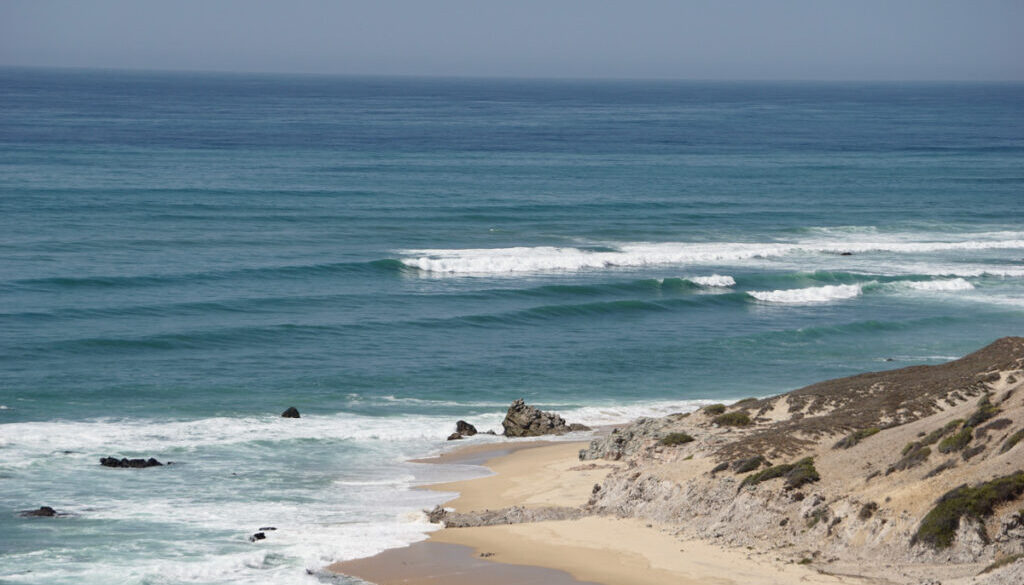
For surfers, the East Cape is one of the most rewarding corners of Baja California Sur. When southern swells arrive during the summer months, they light up the coastline’s many right-hand point breaks, creating long walls of open water against a backdrop that feels worlds away from Cabo’s more developed beaches.
But the waves are only part of the experience.
Where the East Cape is, and why the drive matters
The East Cape runs north from San José del Cabo along the Sea of Cortez, past La Ribera and toward Cabo Pulmo. Some of the best-known surf points are around 40 minutes or more from town, depending on where you’re heading, and the further you go, the more remote it feels.
Some access roads are rough. Cell service disappears. Once you’re out there, there aren’t many places to stop for supplies.
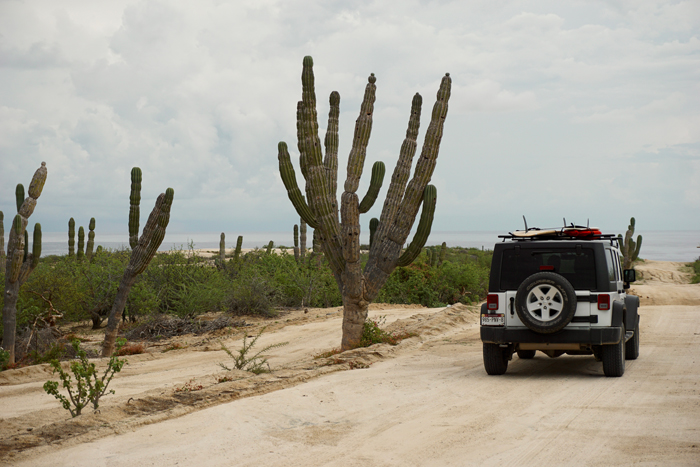
And that’s exactly what keeps the East Cape feeling like the East Cape. Crowds thin out quickly when the pavement ends. On a good summer morning, you can find yourself sharing a world-class point with only a handful of other surfers, which in 2026 is not something you can say about many waves this good.
The drive isn’t something you have to endure to get to the surf. It’s part of the experience.
When to go
The East Cape is primarily a summer surf coast. It faces southeast into the Sea of Cortez, so it needs swell coming up from the south, and that generally means the best window runs from roughly May through October, with conditions sometimes extending into November.
June to August
This is the heart of the season. Southern Hemisphere swells travel north from the South Pacific, the water is warm enough to leave the wetsuit at home, and the points start doing what they were made to do.
It’s also the busiest period. But “busy” on the East Cape still means something very different from busy in California or Europe.
September to early November
If you have flexible dates, this is one of our favorite windows. The swell can still be running, the water stays warm, and the crowds generally thin out after Labor Day.
The trade-off is hurricane season. A tropical system staying safely offshore can send beautiful, organized southeast swell into the East Cape’s corners. A system moving toward the peninsula can do the opposite, shutting things down for days. September is particularly active, so this is a period that rewards flexible plans.
November to April
During the winter months, the Sea of Cortez generally quiets down and the surf moves to the Pacific side of the peninsula. The East Cape can still turn on for an occasional day, but if your trip falls in winter, we’d usually plan around Cerritos and the breaks near Todos Santos instead.
Shipwrecks
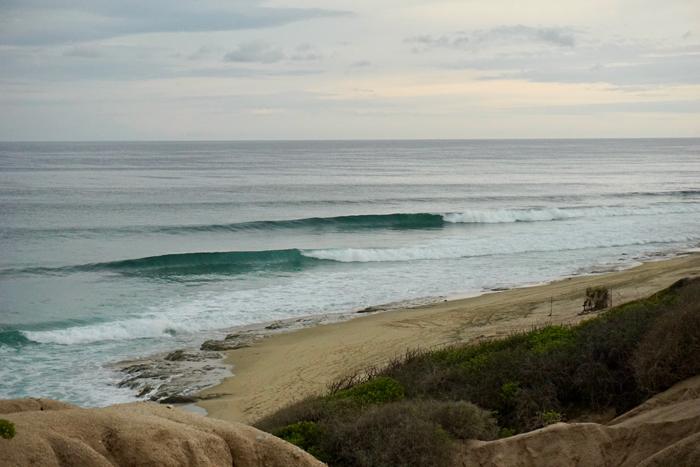
For many surfers, Shipwrecks is the first major stop on an East Cape surf mission. But the story behind the name goes back long before surfers started chasing southern swells along this remote stretch of coastline.
Long before the East Cape became a surf destination, boats and ships navigating these waters had to contend with reefs, changing conditions and a rugged, unforgiving coastline. At the beach now known as Shipwrecks, an old wreck once lay along the reef. The wreck itself is gone today, but its name stayed, passed down from one generation of surfers to the next.
There is something fitting about that. Even today, reaching Shipwrecks still feels like entering another world.
In the early days of Baja surf exploration, getting to places like this meant following rough dirt roads into a coastline with very little infrastructure. As access to the peninsula improved after the Transpeninsular Highway opened in 1973, surfers began exploring further into Baja’s remote coastline, gradually putting many of these previously inaccessible waves on the surf map. Shipwrecks remains one of those places where you can still feel that sense of exploration.
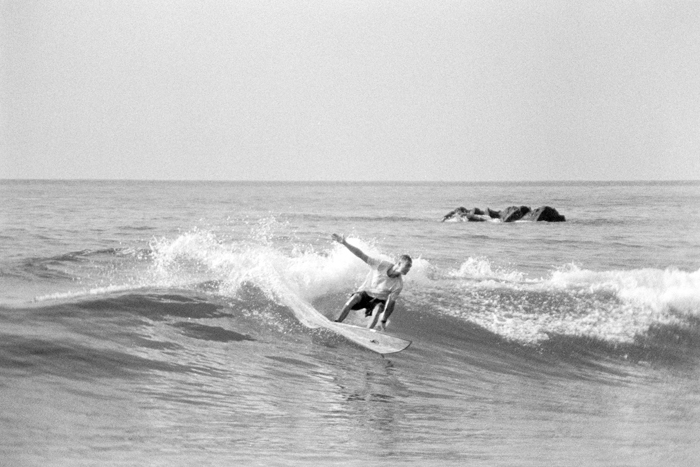
And then there is the wave. When a solid southern swell pushes into the East Cape, Shipwrecks can turn into a fast, powerful right-hand point break. The wave can run through several sections, creating long, open walls with plenty of speed.
Who it suits: Experienced to advanced surfers. You should be comfortable with shallow reefs, steeper takeoffs, fast sections and stronger surf before surfing here. It isn’t an inherently hostile wave, but the reef and the nature of the takeoff mean that it doesn’t suddenly become a beginner wave just because the swell is smaller.
What I would say to you honestly: If you’re not already comfortable surfing reef points and managing your own positioning in the lineup, there are better places to spend your session.
La Fortuna
Between Shipwrecks and Nine Palms, La Fortuna offers another side of East Cape surfing.
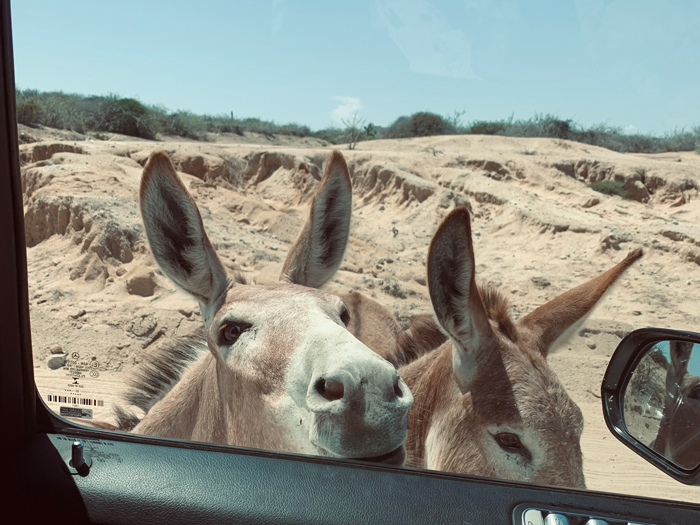
La Fortuna itself is an off-grid coastal community tucked along the dirt road, with a handful of restaurants and a rugged, eco-conscious atmosphere. Don’t expect plazas or grocery stores. Expect solar power, trucked-in water, dusty roads, and plenty of free-roaming Baja locals, from burros to cows. It’s exactly the kind of place where the East Cape starts to feel less like a surf destination and more like an adventure.
The wave is a user-friendly righthander that generally breaks around a rock, particularly as the swell gets bigger. That makes it relatively easy to position yourself in the lineup. It doesn’t usually run as long as Nine Palms, but it can have a little more power. In the right conditions you can occasionally find a left as well, although the rocks and sea urchins make knowing the bottom important.
Who it suits: Competent intermediates through advanced surfers. If you can reliably paddle into green waves, trim down the line and control your board, La Fortuna is a lot of fun.
What I would say to you honestly: Swell size changes this wave more than most. On smaller days it offers softer, more forgiving sections. As the swell builds, the power increases and positioning starts to matter. La Fortuna is also often where we end up when the forecast does not deliver what it promised, and it is the spot that works for a mixed group, one confident surfer and one still building, without either of them having a bad session.
Nine Palms
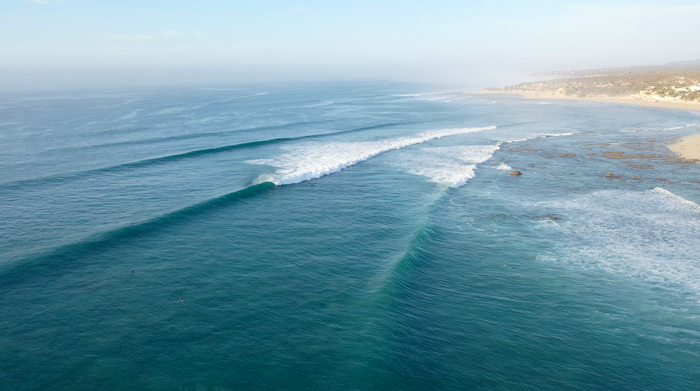
Further down the coast sits Nine Palms, one of the East Cape’s best-known surf spots. It’s named for a group of nine palm trees that historically marked the location at a small local rancho near the beach. There are more than nine palms these days, but they still do the job they always did. You drive through miles of desert past La Fortuna, the road goes on longer than you expect, and then the palms appear and the dirt turns to pavement. That’s how you know you’re there.
The wave itself is a classic East Cape right-hand point. On smaller swells it can be playful and userfriendly, while a stronger southern swell can transform it into a faster, more powerful wave with longer and more demanding sections. On the right day, different sections connect and the wave can run surprisingly far down the point.
Who it suits: Almost everyone, but not equally. On a small to medium day, Nine Palms can be a fantastic wave for confident beginners, intermediates and longboarders. More experienced surfers will enjoy it too, especially when the swell starts to give the wave more shape and speed. When it gets overhead, however, it becomes a different wave entirely: faster, more powerful and less forgiving of poor positioning.
What I would say to you honestly: If you’ve never surfed a point break before, a smaller morning at Nine Palms can be a great introduction to what that experience feels like. On a solid day, it’s a different proposition altogether.
A word on the water, and on the lineup
The current along these points can be strong on bigger swells, and it runs in a direction that is easy to underestimate when your attention is on the wave. That is one of two reasons we do not take surfers into a lineup they cannot handle on their own.
The other reason is the lineup itself. These are small, established communities of surfers, some local and some who have been coming here for thirty years, and a surfer who drops in repeatedly because they cannot read a point is a problem for everyone in the water. Respect out here is not an abstract idea. It is part of why the East Cape still feels the way it does, and part of our job is making sure our guests are welcome back.
More than just a surf trip
What makes the East Cape special isn’t that every session produces perfect waves. It’s the combination of surf, desert and isolation.
You can leave San José del Cabo in the morning, drive deep into the desert, surf a remote point break with only a handful of other people, eat lunch overlooking the Sea of Cortez and watch the light change across the mountains on the way home.
The landscape changes, but so does the pace. There is no rush. You check the swell, you watch the wind, you choose your wave. And sometimes you simply sit on the beach and watch.
It reminds you that you don’t always need more. You just need the right place, the right people and a good wave.
What to bring?
If you’re going on your own, bring more water than you think you’ll need, shade you can set up, sunscreen and zinc, a hat, a spare leash, food, a basic first-aid kit and a full tank before leaving town. And if you’re taking a rental car, make sure you know what it can and cannot handle on dirt roads.
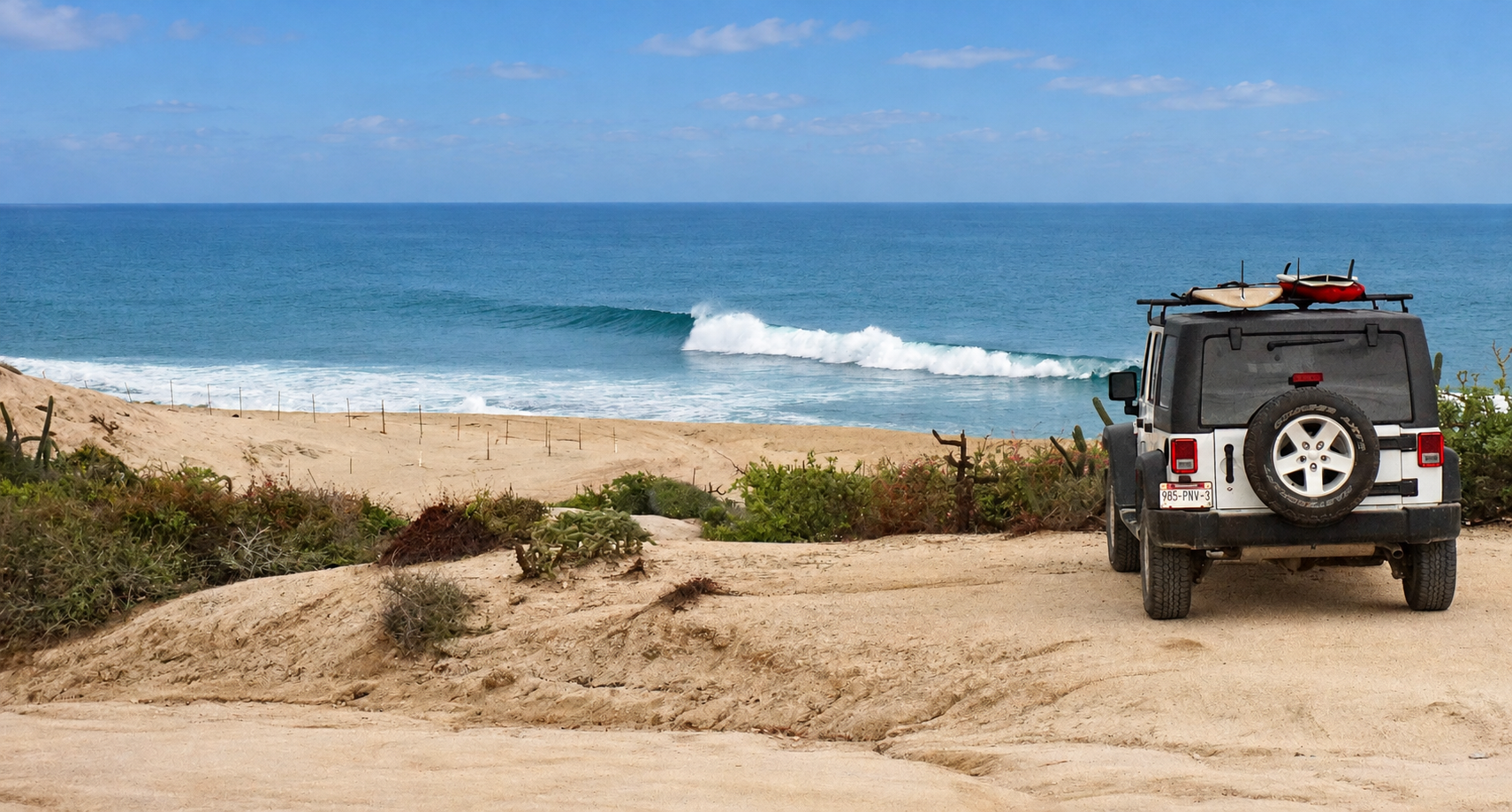
If you’re coming with us, all of that is already in the Jeep.
Which board?
On smaller summer days, Nine Palms and La Fortuna can be great longboard and mid-length waves. One of the most common mistakes we see is bringing too little volume. Most surfers have some of their best sessions of the trip when they ride more board than they normally would.
The East Cape can be waist-high and playful on Tuesday and overhead and serious on Thursday. If you’re not sure what board to bring, let us know, we’re happy to help you choose. And if you don’t want to travel with your entire quiver, we can arrange the right board for your level and the conditions during your stay.
Is the East Cape right for your trip?
Yes, if: you’d like to surf, you’ve got time between May and November, and would rather drive for a quiet point than spend your session at a crowded break.
Probably yes, if: you’re an improving intermediate. The East Cape gives you plenty of opportunities to work on basics, wave selection, positioning, cutbacks and carves.
Not yet, if: you prefer easy access and more predictable conditions. And that’s okay. There are plenty of other waves around Los Cabos that may be a good fit for you.
How we run an East Cape day
The East Cape is one of our favorite places to take surfers who want to experience a different side of Los Cabos. Rather than taking you to the same beach every day, we follow the conditions and choose the coastline that makes the most sense for the swell, wind, tide and your level.
For an experienced surfer, that might mean hunting down a powerful wave at Shipwrecks. For beginners or longboarders, Nine Palms might offer exactly the kind of wave you’re looking for. But there are plenty of other, lesser-known gems too.
We keep our insider knowledge personal and don’t publish every location online. Instead, we use that knowledge to find the best conditions for you while respecting sensitive surf spots and local surf communities.
What happens in the water depends on what you’ve booked. With guiding, we put you in the right place at the right time and let you surf. With coaching, we work on whatever is holding your surfing back. And if you want it filmed, we can shoot from the water, the beach or by drone, then go through the footage with you afterward.
Because out here, it’s not just about finding good waves. It’s about knowing where to look, when to go, and how to make the most of the day.
Ready to surf the East Cape?
Let us find the best wave for your day.